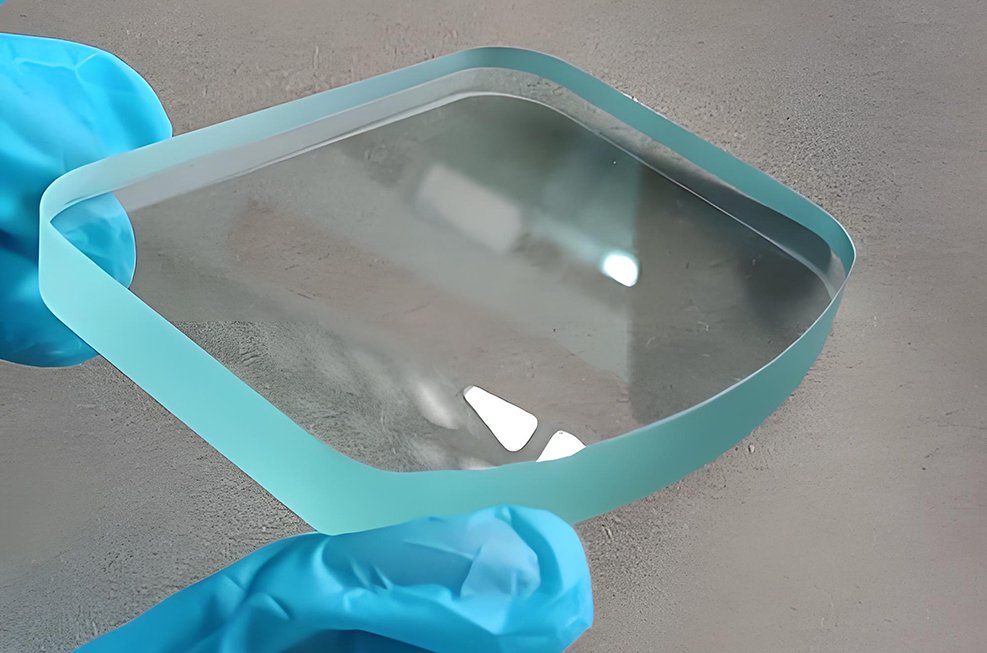
Core Technologies of Glass Surface Profile Processing
1. Flat Glass Surface Profile Processing
Flat glass surface profile processing is the most fundamental and essential type of surface shaping technology. It mainly includes:
- Precision Grinding: High-precision grinding equipment and specialized abrasives are used to uniformly grind the glass surface, removing surface defects and irregularities.
- Ultra-Precision Polishing: Through multiple polishing procedures, the glass surface achieves a mirror-like finish, with surface roughness controlled below Ra 0.01μm.
- Flatness Inspection: High-accuracy inspection instruments such as laser interferometers are used to ensure the glass flatness meets customer specifications.
Our flat glass surface profile processing accuracy can reach λ/10 (λ = 632.8nm), meeting the demanding requirements of high-precision optical glass and electronic glass applications.
2. Spherical / Curved Glass Surface Profile Processing
Spherical glass surface profile processing is widely used in optical lenses, optical instruments, and related industries. The process mainly includes:
- Spherical Grinding: Spherical grinding machines combined with dedicated molds are used to shape glass into the required spherical form.
- Spherical Polishing: Specialized polishing techniques ensure superior surface smoothness and high form accuracy on spherical surfaces.
- Radius of Curvature Control: High-precision curvature measurement instruments are used for real-time monitoring and adjustment of the spherical radius.
We are capable of processing spherical glass with curvature radii ranging from just a few millimeters to several meters, meeting the requirements of various optical systems.
3. Aspherical Glass Surface Profile Processing
Aspherical glass surface profile processing is a highly advanced and precision-demanding technology that mainly includes:
- CNC Grinding: Five-axis CNC grinding machines are used to precisely process glass surfaces according to complex aspherical mathematical models.
- Computer-Controlled Polishing: Computer-controlled sub-aperture polishing technology is applied for localized correction and ultra-precision polishing of aspherical surfaces.
- Molding Technology: Precision molding can be applied for the production of compact digital lenses and miniature optical components.
- Aspherical Inspection: Specialized testing equipment such as aspherical interferometers is used to comprehensively inspect the finished aspherical surfaces.
Our aspherical glass surface profile processing accuracy can achieve λ/5, making it suitable for high-end optical systems and precision electronic equipment.
If you are interested in the decorative glass below, please click [Jewelry Glass]
Table of Text - Table of Text - Textverzeichnis
Toggle